




Gas assist injection molding solves a specific set of problems: thick sections that sink, parts heavier than they need to be, and large parts that would otherwise demand a bigger press. If your part has thick ribs, handles, structural sections, or a mix of thick and thin walls, send the drawing. Lupton reviews part geometry, resin, and annual volume and helps determine whether internal gas assist, external gas assist, or a different molding process fits the part.
How the process works – internal gas assist
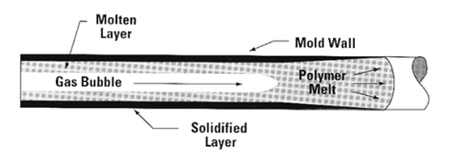
Internal gas assist is a low-pressure variation of conventional injection molding. A short shot of melted resin is injected, then pressurized nitrogen is introduced into the interior of the shot. The gas follows designed gas channels – the path of least resistance – displacing material in the thick areas and forming hollow sections. The gas then packs the molten resin against the cavity walls until the part solidifies, holding dimensions as the part cools. Once solid, the gas is vented from the tool.
Typical advantages, depending on part geometry
- Thick sections without sink marks or surface blemishes
- Part weight reduction – as much as 30% to 40% on suitable geometries
- Improved dimensional stability
- Reduced cycle time versus packing out thick sections conventionally
- Lower clamp tonnage, which can allow a smaller press
- A practical route for metal-to-plastic conversion
Most thermoplastics can run in gas assist, including PP, ABS, PC, PC/ABS, HIPS, and nylon.
How the process works – external gas assist
External gas assist applies nitrogen to the outside surface of the part, still within the mold cavity, to consolidate the component and improve surface definition. It can reduce or eliminate sink marks, cut molded-in stress and distortion, and apply packing pressure more efficiently – which lowers required clamp force, mold wear, and power consumption. It also allows thicker ribs with thinner nominal walls, multi-rib components, and flat PP/PE parts.
What Lupton can review
- Part drawings or CAD with wall sections and rib geometry
- Resin selection and any material substitutions worth considering
- Annual volume and expected tool life
- Surface finish and cosmetic requirements
- Whether your part is a gas assist candidate – or better suited to structural foam, conventional injection molding, or another process
Common fit / applications
- Handles, armrests, and structural members with thick cross-sections
- Large housings and panels where sink and warp are the problem
- Metal-to-plastic conversions targeting weight and cost reduction
- Parts currently molded conventionally with sink, warp, or cycle-time problems
What to include with an RFQ
Part drawing or 3D model
Resin (specified or open to recommendation)
Annual volume and program life
Cosmetic/surface requirements
Timeline or due date
Is gas assist worth reviewing for your part?
Describe the part and the problem you need to solve, such as weight, appearance or an existing molding issue. Share the resin, expected volume and timing if known. You can start with a question; a drawing or model will help us review the next step when it is available.
Ask a gas-assist molding question or send a drawing for an RFQ review.
Frequently Asked Questions
How do I know if my part suits gas assist versus conventional injection molding?
Rough indicators: thick sections that sink, hollow structural members, or clamp-tonnage limits. The real answer comes from a geometry review – send the model.
How much weight can gas assist remove?
On suitable geometries, reductions of 30% to 40% are achievable by hollowing thick sections. Actual reduction depends on part design and gas channel layout.
What resins work with gas assist?
Most thermoplastics, including PP, ABS, PC, PC/ABS, HIPS, and nylon. If your resin is specified on the print, include the callout; if it's open, note that too.
What's the difference between internal and external gas assist?
Internal introduces nitrogen inside the melt to hollow thick sections and reduce weight. External applies gas at the part surface within the cavity to improve surface finish, dimensional stability, and packing efficiency. Part geometry and cosmetic requirements determine which applies.
Related Manufacturing Paths
Injection Molding | Structural Foam Molding | Request an RFQ review