



Progressive die stamping is a tooling investment decision before it's a manufacturing decision. When annual volume climbs past roughly 100,000 pieces and the part's form factor supports a progressive die, per-piece cost can drop substantially – but the die costs real money and takes real time to build. Lupton reviews your print, material, annual volume, and program life and helps determine whether progressive tooling pays off, or whether short run metal stamping still makes more sense at your numbers.
How the process works
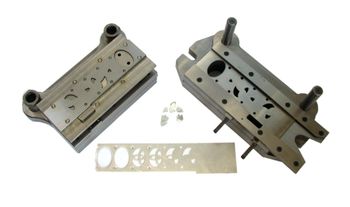
A progressive die runs on a long-bed mechanical press. Material feeds from coil into a die with multiple stations, each performing a sequential operation – blanking, piercing, forming, coining – on the strip. At the final station, a finished part ejects. Because the press produces a complete part every stroke, per-piece cost at high volume is low, and progressive dies can hold tight tolerances repeatably.
Characteristics of a good progressive die candidate
- Small form factor
- High volumes: greater than roughly 100,000 pieces per year
- Higher tooling investment, offset by low per-piece cost
- Longer start-up time than short run tooling – plan the program timeline accordingly
- Tight-tolerance, repeatable features
What Lupton can review
- Part prints with material, gauge, and tolerance callouts
- Annual volume, lifetime volume, and program duration – the payback math
- Coil material availability and strip layout considerations
- Tolerance-critical features that argue for (or against) progressive tooling
- Whether the part should stay in short run stamping until volume firms up
Common fit / applications
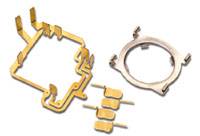
- Terminals, contacts, brackets, clips, and small formed components
- High-volume parts feeding assemblies in electronics, industrial, and OEM equipment
- Parts currently short-run stamped where volume growth has changed the tooling math
- Multi-feature parts where sequential stations replace multiple secondary operations
What to include with an RFQ
Part print (PDF and/or STEP) with tolerances
Material spec and gauge
Annual volume, lifetime volume estimate, and program length
Current sourcing and current piece price, if you're re-sourcing
Timeline – when you need first articles and production
Ready to run the tooling payback numbers? Send the print, material, annual and lifetime volumes, and your timeline through the RFQ form or call (585) 393-4999. If the volumes don't support a progressive die yet, we'll say so – and show you the short run path instead.
Frequently Asked Questions
At what volume does progressive die stamping make sense?
Generally above 100,000 pieces per year, but the honest answer depends on part complexity, material, and program life. The die investment has to amortize across real volume – send actual numbers and we'll do the math with you.
How does a progressive die differ from short run tooling?
A progressive die is a dedicated multi-station tool fed from coil, producing a finished part per press stroke. Short run stamping uses lower-cost die inserts in a master holder with separate operations. Progressive means higher tooling cost, lower piece price, and longer start-up.
My volume forecast is uncertain. Should I wait on progressive tooling?
Often yes. A common path is starting in short run stamping to prove the part and the demand, then converting to progressive dies once volume justifies the investment. We can review both paths against the same print.
Can progressive dies hold tight tolerances?
Yes – repeatable tight tolerances are one of the process's strengths, since features form in fixed sequential stations. Flag the tolerance-critical features on the print so they're accounted for in die design.
Related Manufacturing Paths
Short Run Stamping | Sheet Metal Fabrication | Metal Fabrication | Request an RFQ review